Many Lessons in One Great Chart

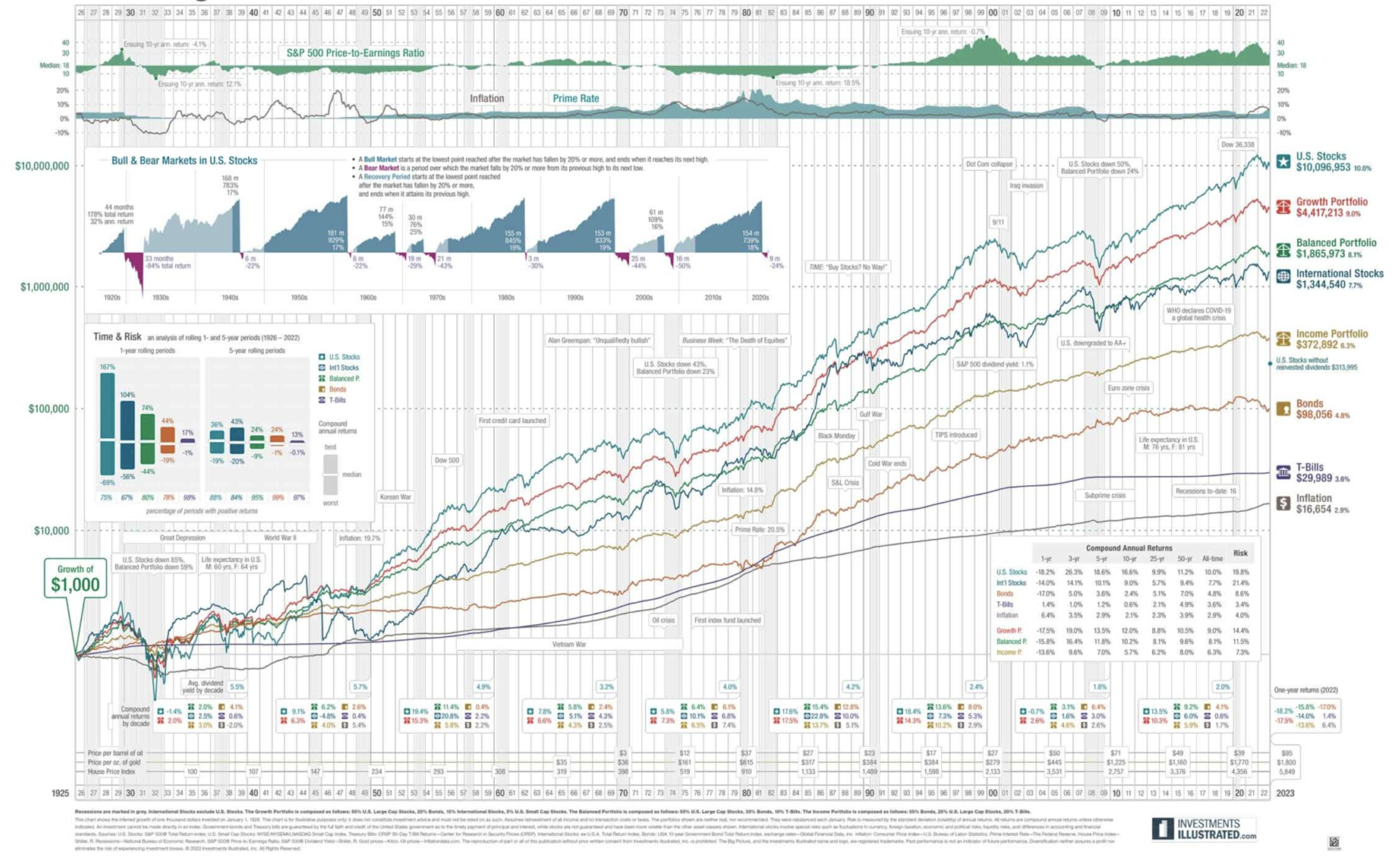
This post looks at one of the most compelling / informative long term charts I've come across. For example, it shows relative PE ratios, interest rates, bond yields, bull and bear markets along with performance. For me, not only does it reinforce the power of time with asset speculation - it also highlights the opportune windows when to add risk (and when not to). The latter is far more important.

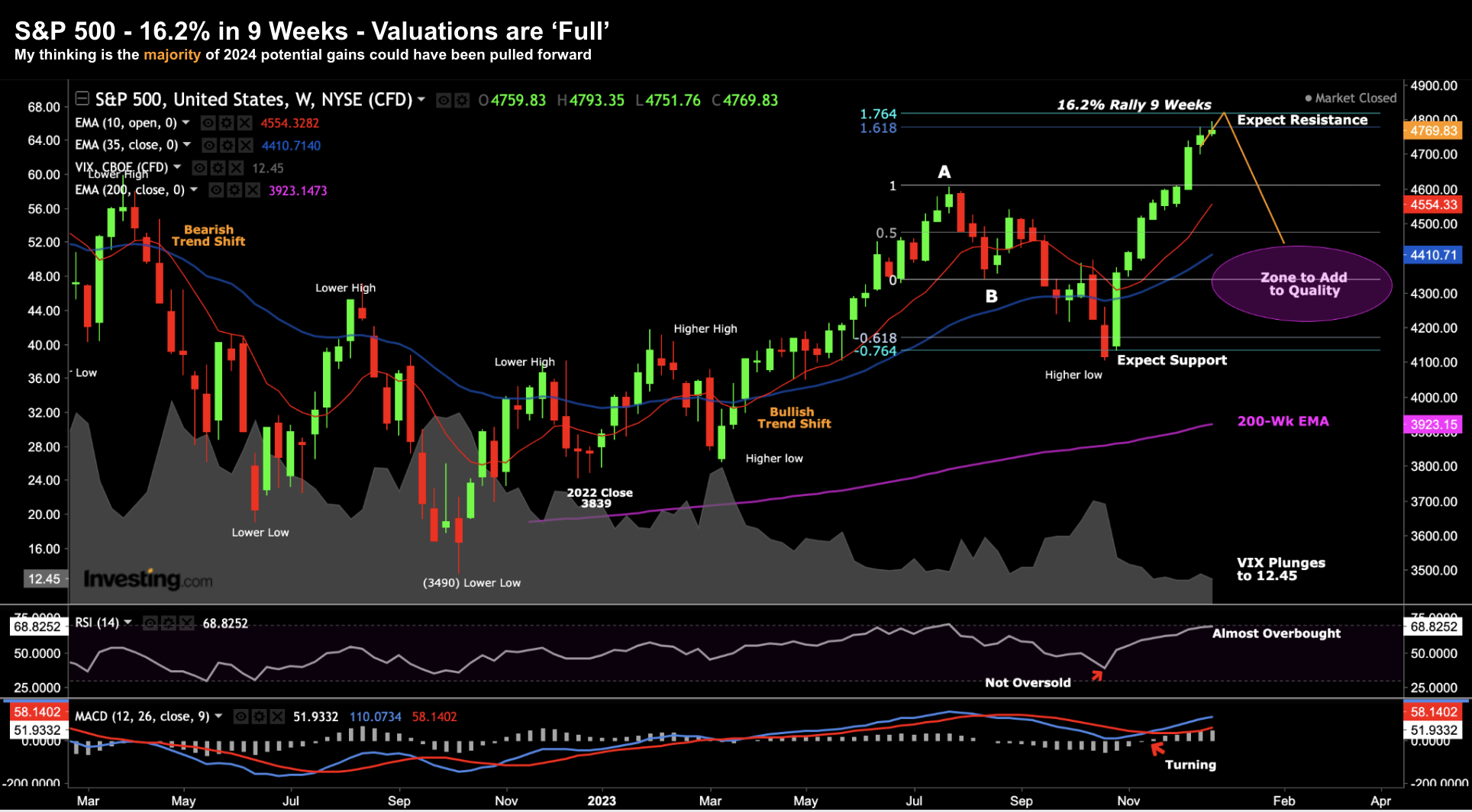
Did We Just Pull 2024’s Gains Forward?

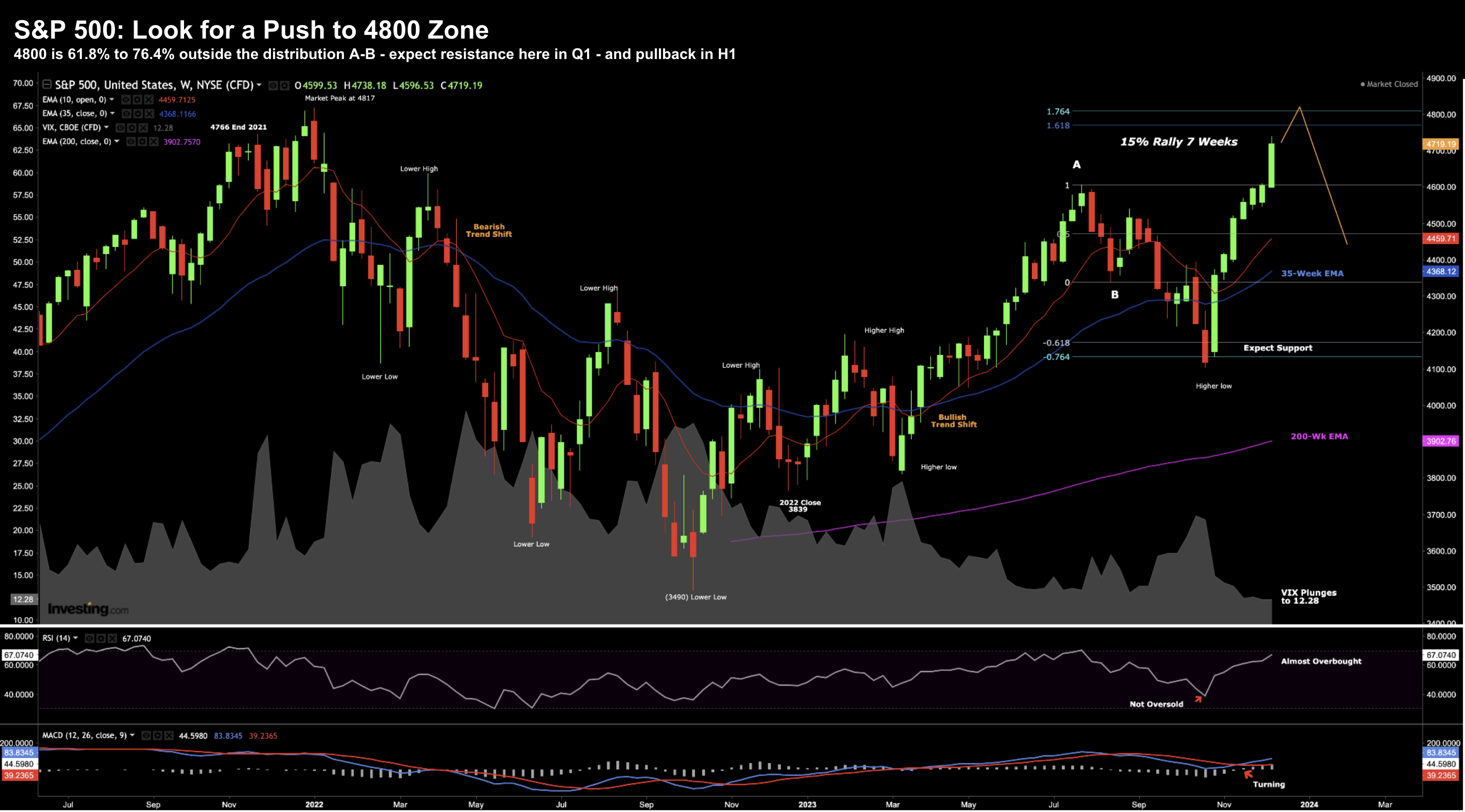
Stocks were already partying into the Fed meeting (up ~12% over 6 weeks) - however when Powell provided his December update on monetary policy - he simply turned up the music. Risk was on. So here's my question - with stocks up an incredible 15% in just 7 weeks - how much of next year's potential gains have been pulled forward? Is it riskier now to buy stocks than it was a few weeks ago? To be clear, stocks are likely to add to their gains before the year is done - however we are now trading close to 20x next years earnings. That's not a bargain.

What Just Happened?

Only two weeks ago Fed Chair Powell said "the FOMC are not thinking about rate cuts". And it was premature to conclude with confidence they are at a sufficiently restrictive level. Well forget all that. Powell performed one of the more remarkable pivots ever seen from the Fed. He pivoted 180 degrees from his sentiment barely 14 days ago. Powell is now talking three rate cuts next year and the Fed have essentially "won the battle" over inflation. My take is the Fed is now more concerned about the business cycle; i.e., recession. There is a reason the Fed will cut - and that is the risk of dislocation in the economy (i.e., recession)

Why Would the Fed Cut? Why Would the Fed Cut?

Why Would the Fed Cut?

Last week the market received what it interpreted as a 'goldilocks' jobs number. Not too hot. Not too cold. But just right. Non-farm payrolls (NFP) increased by 199,000 in November, according to the BLS. This was around 19,000 higher than market expectations - however not hot enough for the Fed to raise rates this week. As an aside, the Government added 49K jobs as part of the 199K (inline with their monthly average). The unemployment rate, meanwhile, fell to 3.7% from 3.9%, marking the longest stretch of unemployment below 4% since the 1970s. That's essentially a full employment picture. So here's my question - why would the Fed consider cuts at full employment?

A Rational Response or Pavlov’s Dog?

Market consensus is for a soft-landing with at least three rate cuts next year. The market does not expect a recession.This may prove correct (I don't pretend to know) - but there are some chinks in the armor. Readers will know I don't subscribe to a soft-landing. Typically in the lead up to a recession - spectators will generally lean towards it being "soft". Few ever forecast 'hard landings'. For example, if you have unemployment below 4% and positive GDP growth - it's hard to see anything else. But very rarely do things land softly. We've seen one over the past five decades. That's not a high ratio. What's more, soft landings are exceptionally rare after 550 basis points of rate hikes (not to mention over $1 Trillion in quantitative tightening - of which we have no parallel).

People Choose What They Want to Hear

Markets continue their ascent after a blistering November. The Dow and S&P 500 each gained ~9% for the month - in what is typically a seasonally strong time of year. From a year-to-date perspective, the Dow is up 8.5%, the S&P 500 is up ~19% and the Nasdaq up over 35%. The anomaly? 493 of the 500 stocks on the S&P 500 are barely positive for the year (i.e., the equal weighted index). So what's driving the optimism? Simple: the expectation of lower yields and the Fed hitting its terminal rate. This post looks at potential blind spots for the market.

Charlie: More than a Brilliant Investor

"The best thing a human being can do is to help another human being know more" - Charlie Munger. Very few things will change your trajectory in life (and/or business) as much as learning and education.The more you dedicate your time to obtaining knowledge - the better you will be. But take it a step further... the pathway your life takes will be a function of the decisions you make. Which begs the question - how does one make higher-quality decisions and/or fewer mistakes? Charlie Munger offered us a framework of mental models to do just that... this will be his real legacy.

Cautious… But Invested

It's a brave person who is short the market. Probabilities suggest we are headed higher in the near-term. For example, previous episodes of Fed pausing suggests stocks typically gain. My sentiment today is best described as 'cautious... but invested'. To that end, one should always be invested to some extent. And whilst it's always unwise to be completely remiss of the risks -- it would be an even greater mistake not to have some exposure to higher quality risk assets and fixed income (at current yields)

Two Reasons the Fed Could Cut Rates

The latest set of economic numbers support a 'goldilocks' scenario for stocks. For example, durable goods orders continue to fall (a positive for inflation); and employment remains robust (a positive for growth). The question is what could cause the Fed to cut rates mid next year (given this is what is priced in)? I will offer two reasons... both of which I think are unlikely before June.

Why I’m Not Betting on a Soft Landing

With the Fed seemingly on pause and bond yields sharply off their highs - markets are optimistic. Equities have surged the past few weeks - up around 17.6% year-to-date. The S&P 500 added 10% in just 3 weeks! The narrative (as far as I can tell) is we're headed for "soft landing". But can we be so sure? Past experience suggests a "hard landing" is the more likely outcome. And absent other evidence, when the Fed hikes this much (and especially this fast) - we should expect one.

Inflation Trending Lower… But More to Do

Today we received CPI for October. It was slightly softer than expected and continues to (slowly) trend lower. That's good news. However, stocks jumped on the data and feel its enough for the Fed to end further hikes. What's more - the market is now pricing in rate cuts as early as March. That feels like a dangerous (aggressive) assumption... I think there's a lot more work to do. Remember - getting inflation down from 4% to 2% is where the hard work begins. Wage growth for example remains at 4.2% YoY.

Fed Warns, Stocks Shrug

"We still have a long way to go" - that was the not-so subtle warning from Jay Powell this week. After what many felt was a slightly less hawkish Fed Chair last week - sparking an equity rally - Powell attempted to adjust his tone at an IMF event. Was he successful? That's hard to say - as equities seemed to shrug off any warning from the Fed - surging ahead to be up 15% year-to-date. Here's my question: are investors being too sanguine about what's still unknown?