
Why a Rising Greenback Signals Global Stress

- The Dollar remains the global system"s essential liquidity anchor
- Strength reflects systemic constraint rather than healthy economic expansion
- Monitor the tension between structural dominance and cyclical erosion
In a conflict with few winners, the US dollar"s resilience stands out.
Since the coordinated strikes by the US and Israel on Iran, the greenback has risen modestly—reasserting its role as the world"s default refuge in periods of stress.
Below is the 10-year chart using the weekly timeframe:

From a technical perspective – since June last year – the dollar index has found strong support.
Towards the end of the last year – I highlighted the positive divergence with the weekly RSI (lower window) – which suggested buying pressure.
However, the last ~12 months saw the currency come under selling pressure — down ~10% from its early 2025 highs.
The question (for traders) is whether the sharp rally this year has been:
(a) driven by a longer-term structural shift; or
(b) simply capital seeking (near-term) shelter?
This is the essence of "King Dollar."
Not dominance in the sense of uninterrupted appreciation, but dominance as the global financial system"s anchor.
In moments of stress, the global financial architecture reflexively tightens around it.
The recent rally reinforces that point.
It doesn"t signal a new regime—it confirms the existing one.
The Safe Haven That Tightens Everything
The dollar is not just another currency – it"s the "plumbing" of the global financial system.
For example:
- Trade is invoiced in it;
- Commodities are priced in it; and
- Debt is issued in it
This creates a structural demand that becomes most visible during periods of stress.
For example, if you need to deploy "hundreds of billions" into a genuinely safe asset, US Treasuries are one of the few places that can absorb that scale.
However, in order to buy US treasuries, you need to first purchase dollars (i.e., demand).
When risk rises, global capital doesn"t just "prefer" the dollar—it requires it.
In other words, during a crisis, liquidity is the only thing that matters, and the dollar is the only game in town with enough "pipes" to handle the flood.
The latest move reflects exactly that dynamic.
Heightened geopolitical risk, rising oil prices, and uncertainty around global growth have driven flows into US assets—treasuries, corporate debt, and equities.
Far from losing relevance, the dollar has once again demonstrated its safe-haven status.
But this strength comes with consequences.
A stronger dollar is not benign. It represents a tightening of global liquidity.
Funding costs rise, financial conditions contract, and pressure builds—particularly outside the United States.
Emerging markets feel it first, but the effects ripple outward into global risk assets.
This is the paradox:
The very feature that makes the dollar a safe haven also makes it a constraint.
When the dollar strengthens, it doesn"t just reflect stress—it amplifies it.
For example, below is a 20-year chart showing the Dollar Index vs the Fed"s Financial Conditions Index

Whilst not perfect – when the dollar strengthen"s – financial conditions typically tighten in parallel.
Cyclical Strength vs Structural Direction
Despite the wartime rally, the broader (longer-term) trend remains less clear.
Part of the dollar"s earlier weakness was not accidental. A softer currency aligned with US policy objectives—particularly efforts to improve export competitiveness.
For example, Trump has made it very clear he wants a weaker dollar
From The Atlantic:
Trump understands that a weak dollar doesn"t sound good. In his first term, he tweeted:
As your President, one would think that I would be thrilled with our very strong dollar. I am not!"
His logic is that the relatively weak currencies of America"s foreign competitors, such as China and Japan, can make their goods cheaper in international markets, and that the United States would do well to replicate their strategy.
This theory isn"t unfounded—a weak dollar would boost the economy in certain respects—but the president"s unpredictable foreign-policy and global-trade decisions are threatening to erode America"s economic standing abroad in a far more significant way.
However, it prompts the following question:
What would have to happen for a President to get his wish of a weaker currency in a world where every other nation is simultaneously trying to devalue their own to stay competitive?"
The recent strength, like the surge in oil prices, is an unintended consequence of geopolitical escalation rather than a deliberate shift in policy direction.
Short-term dollar strength driven by risk aversion does not necessarily translate into sustained appreciation.
In fact, there is a credible case that the medium-term direction may still be lower.
The argument is not about the dollar losing its reserve currency status. There is no viable alternative with the same depth, liquidity, and institutional backing.
Instead, the case rests on policy dynamics.
For example, if the Federal Reserve becomes more tolerant of inflation (e.g., accepting a range between 2.50% to 3.00%) —or is pressured into easing despite elevated price levels—real yields could decline even as nominal growth remains strong.
This would echo the post-global financial crisis period, where quantitative easing suppressed yields and weighed on the dollar despite solid economic performance.
In that regime, the traditional relationship breaks down:
- Strong growth does not strengthen the currency
- Lower real yields become the dominant force
If this was to occur – there is every chance the US dollar can remain structurally dominant while still trending lower.
Reserve currency status is not the same as perpetual strength.
Cracks Beneath the Surface
Even as the dollar reasserts itself in the short term, there are signs of gradual structural erosion.
One of the most important is the shifting dynamic in energy markets.
Historically, oil shocks reinforced the dollar through the "petrodollar" system.
Higher oil prices transferred wealth to producers, who recycled those revenues into US financial assets—particularly Treasuries.
However, what we are witnessing during this current shock could be different.
Disruptions to production and infrastructure—alongside direct geopolitical pressures—are forcing some oil-exporting nations to draw down reserves rather than accumulate them.
Instead of recycling surpluses into US assets, they are selling Treasuries to stabilize domestic currencies and fund wartime expenditures.
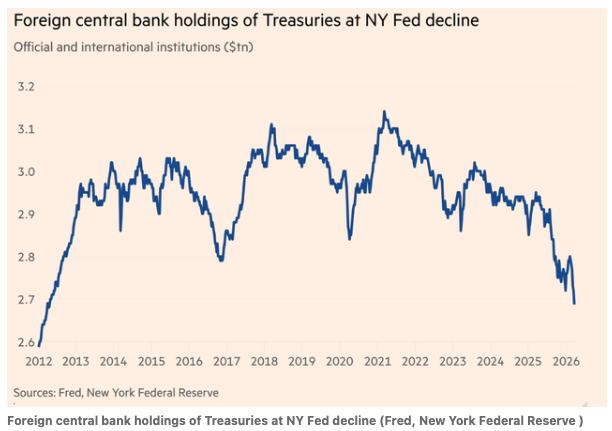
Foreign central bank holdings have already declined meaningfully in recent months.
For example, foreign central banks" holdings at the Federal Reserve Bank of New York have dropped by roughly $82 billion to $2.7 trillion since late February, the lowest level since 2012
According to this article on Seeking Alpha:
- Oil importers such as Turkey, India, and Thailand are likely among those selling as they pay higher dollar-denominated prices for oil, according to Brad Setser, a senior fellow at the Council on Foreign Relations who studies foreign holdings of Treasuries.
- Turkey"s central bank has sold $22B of foreign government securities from its foreign currency reserves since Feb. 27, the day before attacks on Iran were launched, with Setser noting a significant portion were likely Treasuries.
While not yet systemic, the direction is notable.
At the same time, market pricing tells a more nuanced story.
But as I was saying last week – despite the escalation in geopolitical risk – currency, equity and bond volatility has remained relatively subdued.
The euro, for example, weakened initially but has since stabilized—even with oil prices elevated and no clear resolution to the conflict.
This mirrors the pattern seen during the 2022 energy shock.
Volatility spiked early, then faded as markets began to price in eventual normalization.
Current oil futures suggest a similar expectation: that prices will moderate over the next 6 to 12 months.
If that view holds, the dollar"s recent strength may prove temporary.
However, if it doesn"t, renewed pressure—particularly on energy-importing economies—could extend the move.
Either way, the signal is clear: markets are not pricing a disorderly breakdown.
They are pricing stress, but not fracture.
The Signal Investors Should Watch
From mine, if you are assessing the dollar index as either "strong or weak, bullish or bearish" – it"s the wrong lens.
The US dollar is a transmission mechanism.
It aggregates interest rates, capital flows, geopolitical risk, and global liquidity into a single price.
As of today – April 7 2026 – it is sending a mixed signal.
This is the Three Horizon framework I would apply
Horizon 1 – Short Term
- Primary Driver – Safe-Haven Flight
- Market Sentiment – Reflexive Tightening: Capital seeks shelter; liquidity contracts.
Horizon 2 – Medium Term
- Primary Driver – Real Yield Policy
- Market Sentiment – Controlled Softness: The Fed prioritizes growth/inflation over currency strength.
Horizon 3 – Long Term
- Primary Driver – Structural Erosion
- Market Sentiment – Gradual Adaptation: Shifting energy markets and growing debt / deficit levels create a slow "de-peaking."
For investors, this distinction is critical.
Dollar strength in the current environment is not a sign of healthy expansion. It is a reflection of constraint.
It suggests that financial conditions are tighter than headline equity levels might imply.
But as we often say – markets can remain resilient for a time, even as underlying conditions tighten.
However, over time liquidity asserts itself.
And the dollar is often where that process begins.
Final Thoughts
The nature of the US dollar"s role continues to evolve.
For now, it remains as the world"s anchor and core of the global financial system.
But it is no longer a one-dimensional signal of strength.
It is, increasingly, a barometer of tension—rising in moments of stress, softening under policy pressure, and gradually adapting to a more fragmented global landscape.
It would be remiss of investors to view the dollar as either dominant or declining. It is both.
And in that tension lies the signal.