Category Valuations

Don’t Bet on 50 Bps for Sept.

Do we have a 'good, solid' economy or one that's at risk of a recession? Is the employment market robust or one that's slowing sharply? Should the Fed cut 50 basis points or 25? And if 50... why? These are not easy questions to answer - as you can make the case either way (pending your lens). Regardless, the popular narrative is one favoring a soft-landing. Jay Powell echoed this sentiment with a victory lap at Jackson Hole. Former Fed Chair Janet Yellen supported this thesis over the weekend...

It’s Not Only Falling Inflation & Growth Risks Driving Rate Cuts

As inflation continues to moderate and the employment picture weakens - markets are trying to gauge just how much the central bank will move. A 25 basis point (bps) cut for September is now a 100% probability according to CME Group’s FedWatch tool. There's a 63.5% chance of a 25 bps cut; and 36.5% of a 50 bps cut. Markets clearly want 50 bps... but they also know that very rarely is there just "only one rate cut". This post explores the relationship between debt growth (across all sectors) and the overall trend for interest rates. It's a relationship which is not often discussed - but would be remiss of investors to ignore.

What Does Kolanovic See That Others Don’t?

Most analyst year-end S&P 500 targets range from 4200 to 5600 for equities; and 3.00% to 4.75% for 10-year yields. My guess is we will land somewhere in between these zones. On the whole, it's fair to suggest Wall Street feels 'comfortable' with holding equities. Consensus year end targets average 5400 - which tells me most don't expect stocks to do much between now and year's end. More important - they don't expect stocks to lose any ground. This post expands what I think is the single most important variable (and risk) with these forecasts: the relative health of the US consumer and their ability to continue spending.

Apple: Ready to Take Another Bite?

Apple is ~15% off its all time high as it lags its large cap peers. Concerns of iPhone growth and China have rattled investors. However, it's not unusual for this stock to pull back. Since 2107, we have seen 11 retraces - offering patient investors buying opportunity. From my lens, Apple is a reasonable long-term buy around $165. And if you can get it cheaper - add to it. Over the next 3 years - I think it will be well over $200 as earnings top $8.00 per share.

Three Cheers for 5,000!

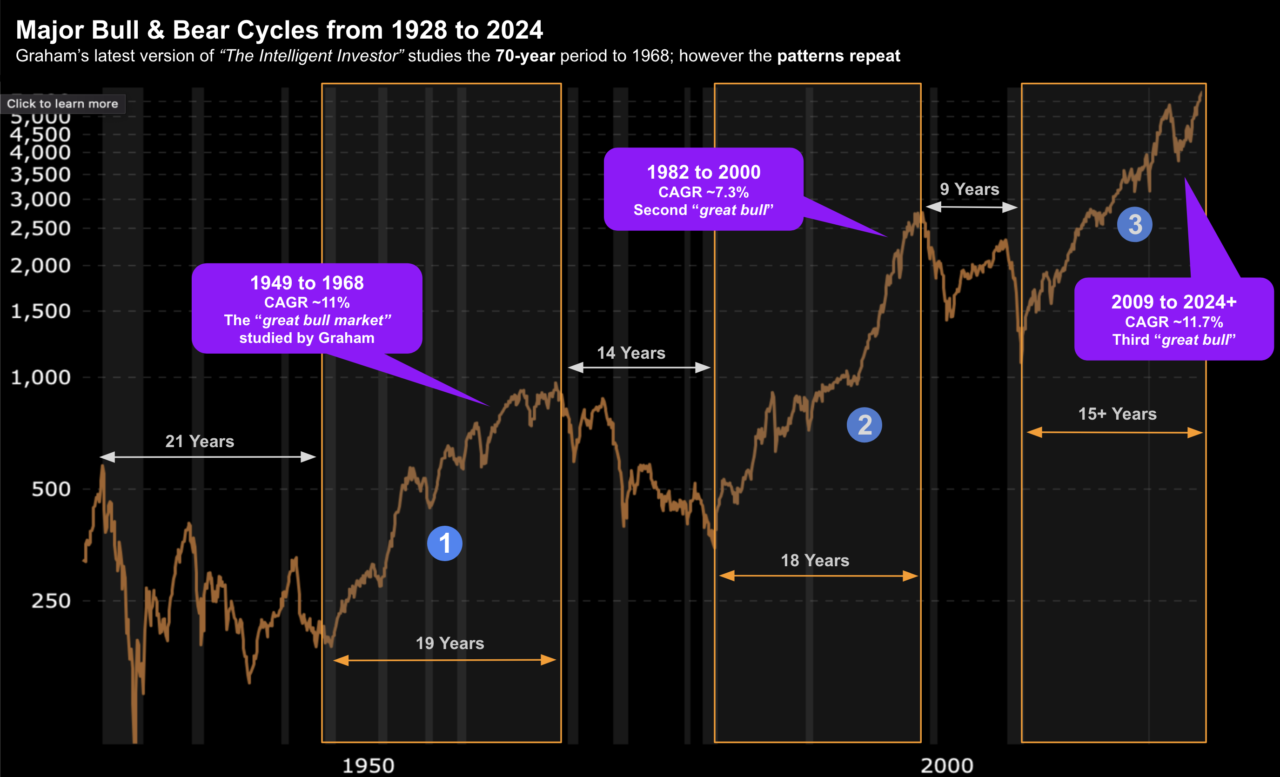
This week the S&P 500 closed above 5,000 for the first time. Another milestone as we climb the 'wall of worry'. Over the past 100+ years the S&P 500 has averaged capital gains of ~8.5% per year plus dividends of ~2.0%. That's a total return of close to 10.5% (on average). If you compound 10.5% per year over 20 years (i.e., 'CAGR') - that's a 637% increase. But as we know, the pathway is rarely smooth. Some years the market may "add 20%" and others it could give back a similar margin (or worse). And we saw this happen recently. However over the long run - markets will rise more often than they fall.

2023 – The Year in Review

2023 has come to a close... and what a year it was. For many, it will go down as one of the more challenging. For others, they will have banked some very attractive gains. In short, the S&P 500 recovered from its worst year in over a decade - finishing the year 24.2% higher. As for myself, my portfolio returned 19.63%. I made some errors this year (which I will discuss) but also had a couple of wins. Net-net - it was a solid year given the unchartered waters we were navigating.

People Choose What They Want to Hear

Markets continue their ascent after a blistering November. The Dow and S&P 500 each gained ~9% for the month - in what is typically a seasonally strong time of year. From a year-to-date perspective, the Dow is up 8.5%, the S&P 500 is up ~19% and the Nasdaq up over 35%. The anomaly? 493 of the 500 stocks on the S&P 500 are barely positive for the year (i.e., the equal weighted index). So what's driving the optimism? Simple: the expectation of lower yields and the Fed hitting its terminal rate. This post looks at potential blind spots for the market.

Not Just Equities Trading ‘Per the Script’

A little over 2 months ago - I described the market as "euphoric". For example, valuations were in excess of 20x forward earnings - despite what we saw in bond markets. Something was horribly wrong. My simple advice was do not add to positions at those levels. The downside risks were just too high. My thesis was whilst stocks could easily rally to ~4500 -- any further meaningful upside felt 'limited' . Turns out we didn't go too much higher. Now stocks could easily catch a bid in the 4200 zone - that's what I expect. However, the risk/reward still doesn't look that favourable...

The Battle-lines are Drawn

Here's today's question: do you think 18.3x forward earnings is a good risk/reward bet? For me, the answer is no. And I say this because investors have a very compelling alternative. We don't need to look any further than bond yields. For example, the 12-month US treasury yield offers investors 5.45%

Stocks Treading Water for a Good Reason

Stocks cannot get out of neutral. If anything, they appear to be going into reverse. Makes sense... they ripped~ 30% higher in 9 short months. But the risks are increasing as prices rise. This post looks at "equity risk premium". In short, investors are not being adequately compensated for the risk being taken in stocks (at current valuations) against the risk free return from Treasuries.