How Central Banks Shape Markets in Times of Crisis

- Central banks operate under constraints, balancing inflation control against economic growth risks
- Markets react as much to uncertainty and ambiguity as to policy decisions
- Forecast precision collapses in crises; investors should think in scenarios, not predictions
Every crisis feels unprecedented in the moment.
A war disrupts oil supply. Prices spike. Markets lurch. Commentators scramble to interpret what it all means.
Faced with such uncertainty, attention quickly turns to central banks.
Rate decisions, policy statements, and even subtle shifts in tone are scrutinised for clues.
But are central banks a panacea?
Unfortunately not.
They are unelected stewards of price stability—tasked with responding to forces they do not control.
And if we step back, the specific catalyst matters far less than the pattern.
Whether it is the oil shocks of the 1970s, the Global Financial Crisis of 2008, the pandemic of 2020, or a geopolitical conflict, the same underlying dynamics tend to repeat.
For investors, it is not about predicting the next shock—or where markets will be in three, six, or twelve months.
That is not where the edge lies. The key to success is understanding how systems behave under stress.
Anatomy of a Shock
A spike in the price of oil is a useful case study because it embodies a fundamental economic tension.
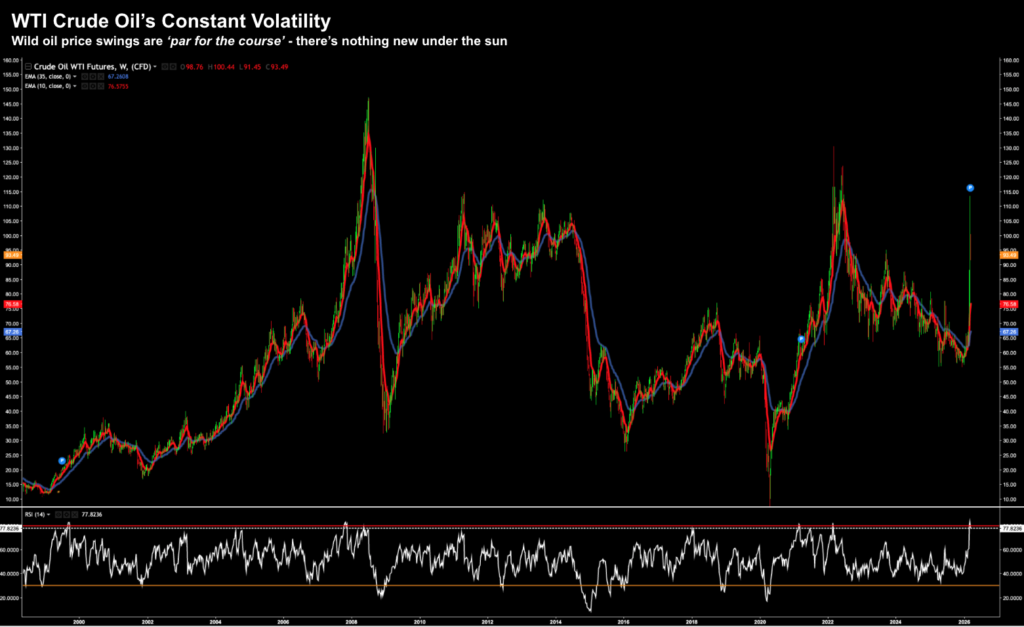
When energy prices surge, inflation rises. But at the same time, economic activity slows.
Consumers are forced to pay more for essentials, leaving less for discretionary spending. Businesses face higher (input) costs and growth weakens.
This creates a dilemma for central banks.
Should they raise rates to fight inflation? Or cut rates to support growth?
This tension is not new.
It is the essence of what economists call "stagflation," and it defined the policy mistakes of the 1970s.
Central banks that responded too slowly to inflation lost credibility. Those that tightened too aggressively crushed growth.
The lesson is not that central banks should always act one way or the other.
It is that they are always operating under constraints—and often —those constraints are mutually incompatible.
What Central Banks Can—and Cannot—Do
Something that has always fascinated me is our over-reliance on central banks.
As investors – it feels like we sweat every syllable which comes out of their mouth.
And when they move on short-term interest rates – it dominates the headlines.
A critical but often overlooked point:
Central banks do not control the source of most economic shocks.
They cannot pump more oil. They cannot resolve wars. They cannot fix supply chains. And above all else – they cannot control the spending and saving behaviour of consumers.
What they can do is partially influence financial conditions via two blunt instruments:
- short-term interest rates
- liquidity and credit availability.
Put another way – central banks have indirect power.
They have the ability to shape demand – but not supply.
Now coming back to the current oil "shock" — this is why policymakers often focus on "core" inflation (and not headline)
Core inflation will strip out volatile components like energy and food.
It is an attempt to isolate the part of inflation they can plausibly influence.
But here lies a subtle risk…
If policymakers look through a shock that turns out to be persistent, they fall behind the curve.
For example, this was the mistake they made with COVID.
Powell incorrectly labelled inflation as transitory. He (and the Fed) didn"t admit their mistake until it was far too late. They fell behind the curve and were forced to dramatically raise rates.
In turn the market was caught off guard. Many smaller banks collapsed.
However, if central banks were to react too quickly to what proves temporary, they risk unnecessary damage.
In other words, they are constantly making probabilistic bets under uncertainty.
At times, however, the uncertainty itself becomes overwhelming.
In such environments, central banks don"t just lack clear answers—they may actively choose not to provide them.
Ambiguity becomes a policy tool. By withholding forward guidance or avoiding firm commitments, policymakers preserve flexibility in a world where the distribution of outcomes is unusually wide.
This pattern has appeared in multiple cycles—from the stop-start policy responses of the 1970s to more recent periods where forward guidance was deliberately softened or withdrawn when conditions became too fluid.
In summary – whilst we often look to central banks for answers – don"t expect them.
Calm or Complacent?
At the time of writing (March 20) – markets are remarkably calm in the face of the heightened uncertainty.
For example, the S&P 500 is fractionally below its all-time high (despite the headlines)

Inflation expectations remain anchored. Real interest rates barely move. Risk assets hold up better than expected.
Question: do you consider this resilience or complacency?
You will hear arguments for both… and history is littered with examples.
Before the Global Financial Crisis of 2008 – markets largely ignored growing risks in housing and credit. In contrast, during other periods, markets have overreacted, pricing in worst-case scenarios that never materialized.
The key insight is that markets are not omniscient.
They are adaptive systems, shaped by narratives, positioning, and feedback loops.
When expectations shift—even slightly—the resulting moves can be nonlinear.
Crucially, markets are driven not only by what policymakers say—but also by what they refuse to say.
Periods of deliberate ambiguity or non-commitment can provoke sharp reactions, as participants attempt to infer intent from silence. In this sense, "non-information" can be as powerful as explicit guidance.
Blind Spots and the Illusion of Precision
One thing I"ve come to appreciate over the past ~30 years investing – it"s the illusion of precision.
It is far better to be directionally right than precisely wrong.
As a life-long student of Charlie Munger – his principle of inversion is something I apply daily.
"Invert, always invert."
For example, instead of asking, "what will central banks do?" a more useful question might be: "what would have to go wrong for the consensus to fail?"
- What if core inflation proves stickier than expected?
- What if growth deteriorates faster than policymakers anticipate?
- What if political pressure distorts decision-making?
- What if markets are mispricing risk?
The process of inversion forces us to confront blind spots. We all have blind spots. Our job is to figure out where they are.
For example, investors often assume central banks will act rationally and independently.
But history shows that political pressures can and do influence outcomes.
Leadership changes, electoral cycles, and public sentiment all shape the policy environment.
Similarly, there is often an implicit belief that inflation expectations are "anchored."
But anchoring is not a law of nature—it is a fragile equilibrium— built on credibility that can be lost.
Which brings me to the fallacy of forecasts.
Perhaps more than anything else – many investor"s largest blind spot is overconfidence in forecasts.
For example, barely a week goes by where markets constantly update expectations for interest rates—how many cuts, how many hikes, when they will occur.
This is a futile exercise – as these projections can change dramatically within weeks.
Case in point:
At the start of the year the market was pricing in two to three rate cuts. Today markets are pricing in the possibility of a rate hike.
This creates an illusion of precision.
In reality, central banks themselves do not know the future path of policy.
Jay Powell will be the first to admit it.
They react to incoming data, which is often revised, noisy, and incomplete.
And the more uncertain the world becomes, the faster these consensus forecasts tend to collapse (as we have seen).
Moments of crisis expose how fragile seemingly precise expectations really are—whether during the rapid repricing of policy paths in 2008, the pandemic shock of 2020, or inflation surprises in more recent cycles.
What"s the lesson?
Uncertainty is irreducible.
Therefore, rather than trying to predict exact outcomes, it is often more productive to think in ranges and scenarios.
7 Lessons for Investors to Take Away
#1. Every cycle has its blind spot(s)—areas where risks are under-appreciated. Nassim Nicholas Taleb discusses this at length in his books:
- Fooled by Randomness: The Hidden Role of Chance in Life and in the Markets
- The Black Swan: The Impact of the Highly Improbable
- Antifragile: Things That Gain from Disorder
#2. Second-order effects: Initial shocks often trigger cascading consequences that are harder to predict.
- See this on the second-order effects of tariffs
#3. Feedback loops: Market moves can influence policy, which in turn affects markets.
#4. Narrative shifts: Changes in dominant narratives can rapidly alter behavior and pricing.
#5. Structural changes: What worked in one era may not apply in another.
#6. Policy ambiguity: Uncertainty around policy direction can itself drive market outcomes.
#7. False precision: Apparent clarity in forecasts often masks deep uncertainty.
- The most dangerous belief is "this time is different"—or conversely—that it is exactly the same. Both lead to poor decisions.
A Final Thought
Central banks are often portrayed as all-powerful, capable of steering economies through any storm.
They are not.
In reality, they are more like navigators than engineers—adjusting course in response to conditions they cannot fully control.
Crises will come and go. Oil shocks, financial panics, geopolitical conflicts—each will feel unique in the moment.
But the underlying dynamics will rhyme.
And in some of the most critical moments, it is not just policy decisions that matter—but the uncertainty surrounding them.
Ambiguity, silence, and shifting expectations are not side effects of the system; they are part of how it transmits stress.
For investors, the goal is not to predict every twist and turn.
That is not possible.
It is to build a framework that endures.
Because in the end, the biggest risk is not the shock itself. It is misunderstanding how the system reacts when it arrives.
In closing:
- Focus on systems, not events: the specific trigger matters less than how the system responds.
- Expect trade-offs: there are no perfect policy choices—only competing priorities.
- Embrace uncertainty: precision is often illusory; scenario thinking is more robust.
- Use inversion: identifying what could go wrong is often more valuable than predicting what will go right.
- Watch incentives: Policymakers, like all actors, respond to incentives and constraints
- Stay humble: Markets and economies are complex adaptive systems. Overconfidence is costly.