
Why Stock Valuation Multiples Matter More Than Growth

- Returns are driven more by valuation multiples than earnings growth
- Overpaying for quality leads to poor long-term investment outcomes
- Multiple compression can erase years of strong business performance
Those who have been reading my blog over the past ~15 years will have heard me say "buying the best company in the world can still be a terrible investment".
This is one of the most uncomfortable truths in investing and it runs opposite instinct.
Investors are naturally drawn to quality—strong brands, dominant market positions, high operating margins, consistent earnings.
It feels safe. Rational. Obvious.
But markets don"t reward quality alone. They reward expectations relative to reality.
And those expectations are embedded in one simple number: the multiple.
In other words, how much you are paying for quality.
Whether it"s price-to-earnings, EV/EBIT, or price-to-free cash flow, the multiple you pay is not just a detail in the investment process—it is often the primary determinant of your long-term return.
The Equation Investors Forget
At its core, long-term equity returns can be broken down into three components:
- Earnings growth
- Dividends; and
- Change in Valuation Multiple
Most investors focus almost entirely on the first.
They search for businesses that can grow earnings at high rates over long periods of time.
But the third variable—the change in multiple—is often far more powerful.
For example, a great business growing earnings at 10% annually can still deliver poor returns if its valuation falls from 40x earnings to 20x.
Conversely, an average business can produce strong returns if its multiple expands.
In other words, it"s not simply about investing in a high quality business.
It"s high quality at the right price.
For decades, conventional wisdom held that high-multiple stocks deserved their premium because they would grow faster in the future.
Expensive stocks were seen as "growth stocks"—companies whose earnings would eventually justify their valuation.
But research from leading academics, including work out of Wharton School, challenges this assumption.

Wharton"s findings are striking:
- Differences in valuation multiples are driven far more by future returns than by future earnings growth
- Roughly 75% of variation in multiples is explained by differences in returns
- Only ~ 25% is explained by actual earnings growth
In other words, Wharton concluded that high-multiple stocks do not reliably grow faster than their peers.
They simply go on to deliver lower returns. This flips the traditional narrative on its head.
Mean Reversion: The Invisible Force
Today that market has an infatuation with high multiple "growth stocks".
Take the Mag 7 – they comprise around 35% of the total S&P 500 market capitalization.
Beyond the Mag 7 – there are names such as (not limited to) Crowdstrike, Ely Lilly, Palantir, Broadcom, PaloAlto Networks, ServiceNow and AppLovin are all often among the most traded stocks.
But from mine, the term "growth stock" is one of the most misleading labels in investing.
It implies that companies trading at high multiples are fundamentally different—that they possess superior growth prospects that justify their premium valuation (e.g., price to free cash flow, price to earnings etc)
But in practice, this often isn"t true.
Many high-multiple companies are indeed high quality. For example, investors would be hard pressed to find a high quality company than Nvidia in terms of its margins, free cash flow, consistent earnings and competitive moat.
However, this does not mean their growth rate from this point forward will exceed expectations.
And that distinction matters.
Because if future growth does not exceed what is already priced in, the only remaining adjustment mechanism is the multiple itself. And multiples, over time, tend to mean revert.
Think of it this way:
Valuation behaves like gravity. It can be ignored for a while. Sometimes for years. But it is never permanently suspended.
Across markets and across decades, valuation multiples tend to revert toward a long-term average (e.g. the rising blue line below)
Nowhere is this dynamic more visible than in today"s market.

The black line is the ebbs and flows of multiples.
During times of fear – they tend to compress – often falling below the long-term mean. During times of optimism and greed – they expand well above the mean.
Historically, over a 5–10 year horizon, the pattern is remarkably consistent.
That is, high multiples come down and low multiples rise.
They mean revert.
This process—multiple compression or expansion—is one of the most powerful forces in investing.
However, it is also one of the least appreciated.
The reason it"s the least appreciated is because of how slowly it works.
At first, a high-multiple stock can continue to perform well. Momentum builds. Narratives strengthen. Investors extrapolate recent success into the future.
But eventually, reality intervenes.
This doesn"t necessarily show up as collapsing earnings. Often, earnings and sales continue to grow. The business performs well.
But the stock doesn"t.
A stock like Nvidia is a great example. The stock has barely advanced the past couple of years.
The reason:
Even when earnings and cash flow surge, stock prices can stall if the starting valuation is too high

Walmart: A Case Study
Nvidia is not our only example.
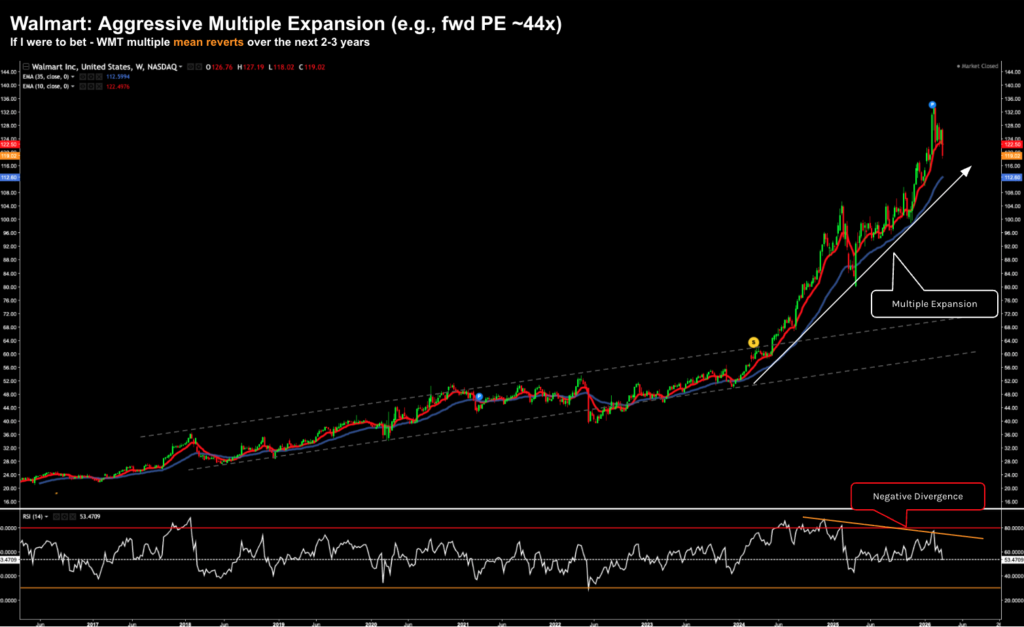
Consider the recent performance of Walmart (WMT)
It"s also one of the highest quality stocks you can own – the best in its class.
Over the past year, Walmart"s share price has experienced significant appreciation – up over 25%
At first glance, this might suggest a meaningful improvement in the company"s underlying fundamentals.
But a closer look tells a different story.
Walmart remains what it has always been: a dominant retailer
It"s a highly efficient operator with relatively stable, but modest, growth.
There has been no step-change in earnings power to justify this re-rating. And no sudden surge in profitability that would justify an outsized re-rating on fundamental grounds alone. And yet, the stock has moved sharply higher.
Why?
Multiple expansion.
At ~$119 – WMT trades at a forward PE of around 44x.
That is approximately twice the market (where the S&P 500 trades around 21x its forward earnings – vs its ~18x 10-year average)
WMT"s price to free cash flow (P/FCF) – a better measure of valuation – trades at 68x – which is 216% more than its average.
This means you are paying $68 for every $1 the company generates. Put another way, it would take 68 years to get your $1 back from the company"s current cash generation (assuming no growth and no reinvestment).
That"s a very high multiple to pay.
Now I will be the first to admit that the narrative for WMT has improved—resilience, scale, pricing power etc.
Again, I"m not here to argue about the quality of its business. In their category – they are second to none.
But the underlying earnings trajectory has not changed nearly as much as the stock price.
This happens constantly in markets and illustrates a critical point:
Even for stable, mature companies, a large portion of returns can come not from earnings growth, but from changes in valuation.
And just as multiples can expand, they can also contract.
Why Do Investors Keep Overpaying?
To understand why valuation matters so much, consider a simple thought experiment (using Walmart):
- Imagine you buy a high-quality company like Walmart at 44x earnings
- Over the next decade: earnings grow at a healthy 10% annually
- The business performs exactly as hoped – delivering on its 10% EPS growth
- But over that same period, the multiple declines from 44x to 22x (more in line with its mean)
- What happens to your return?
Let"s walk through the math:
- Earnings per share (EPS) today = $119 ÷ 44 ≈ $2.70
- Grow Earnings at 10% for 10 Years -> EPS = $2.70 × (1.10)¹⁰ ≈ $2.70 × 2.59 ≈ $7.00 EPS (i.e. tripling)
- Apply the Lower Multiple (22×) -> $7.00 × 22 = $154
- $119 to $154 is an ~29% gain over 10 years
- CAGR ≈ ~2.6% per year
2.6% pear year is lower than the current rate of inflation.
Despite strong earnings growth, your investment delivers minimal or even negative real returns.
Now nothing went wrong with the business. In our example, Walmart grew its earnings by an impressive 10% every year for 10 years.
Everything went wrong with the price you paid (i.e., 44x its current earnings)
This is the core risk of high-multiple investing.
It is not that the company will fail. It is that the expectations embedded in the valuation are so high that even good outcomes are insufficient.
So why do investors continue to pay high multiples?
There are a few recurring reasons:
- Compelling stories—technological change, market disruption, structural growth, this time is different—can justify almost any valuation in the short term.
- Recency bias — investors extrapolate recent performance into the future, assuming that what has worked will continue to work
- Quality bias — high-quality businesses feel safer, leading investors to believe that valuation is less important
- Fear of Missing Out — when a stock is rising, the pressure to participate can override valuation discipline.
None of these forces are new.
They have appeared in every market cycle, from the "Nifty Fifty" era to the dot-com bubble to the AI boom today.
And they all lead to the same outcome: overpaying for certainty that doesn"t exist.
The Discipline of Paying Less
Something else I"ve noticed in the market is the framing of "value" versus "growth".
This misses the point.
The real distinction is not between cheap companies and growing companies. The better distinction is between:
- Expectations that are too high
- Expectations that are reasonable or low
A so-called "value stock" often delivers strong returns not because it is a better business, but because its starting valuation leaves room for positive surprise.
A "growth stock," on the other hand, often disappoints not because it is a bad business, but because it fails to exceed already elevated expectations.
This is why, over long horizons, lower-multiple stocks have historically outperformed higher-multiple ones.
Not always. Not in every period. But consistently over time.
There will be cases when a high multiple stock will continue to outperform for many years. However, those cases are more isolated.
The practical implication is straightforward, but not easy: the price you pay determines your return.
This doesn"t mean investors should only buy the cheapest stocks. Nor does it mean avoiding high-quality businesses. It means applying discipline.
When evaluating an investment, the key question is not: "is this a great company?" It is: "what expectations are already embedded in this price?"
And more importantly: "what would need to happen for this investment to deliver a satisfactory return?"
If a company is trading at "44x earnings" — the implied growth assumptions are enormous.
Earnings may need to triple to justify the current valuation.
That is a high bar.
History suggests that, on average, most companies (not all) fail to clear it.
Putting it All Together
Applying Charlie Munger"s technique of inversion – instead of asking how to achieve great returns, ask: how do I guarantee poor returns?
Simple: pay a very high multiple.
And whilst stocks can trade higher on momentum in the short term — over a long enough horizon — it is one of the most reliable ways to underperform.
Great businesses create value. They compound earnings. They build durable competitive advantages. Nvidia and Walmart are two great examples.
But investors do not automatically benefit from that compounding.
Because investing is not just about owning a business. It is about the terms on which you buy it.
And those terms are defined by the multiple.
Valuation determines whether investors actually participate in that compounding.
In the end, the multiple isn"t just part of the story—it determines how the story ends.